
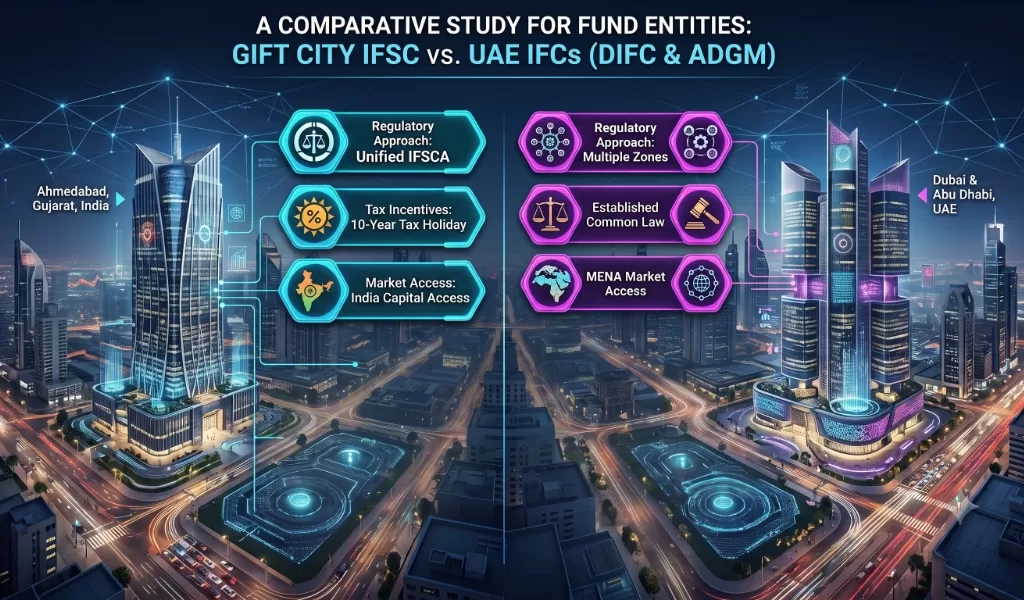
Over the last few years, one question has come up in almost every conversation we have with fund managers, family offices, and financial services entrepreneurs: “Should we set up our fund in GIFT City or in the UAE?” It is the right question to ask. Both destinations have emerged as serious contenders for cross-border fund structuring, and the choice between them is no longer obvious — it depends on your investor base, your strategy, and your cost structure.
India’s GIFT City IFSC, regulated by the unified IFSCA, has moved with remarkable speed — introducing the Fund Management Regulations, a generous tax holiday, zero transaction taxes, and a clear mandate to “onshore the offshore”. On the other side, the DIFC in Dubai and the ADGM in Abu Dhabi bring two decades of institutional credibility, English common law familiarity, and unmatched proximity to Middle Eastern sovereign wealth and family office capital.
In this blog, we present a structured, section-by-section comparison of the two jurisdictions across regulation, licensing, fund vehicles, taxation, market access, and operating costs — followed by our own independent view at the end on how fund managers should think about this decision.
This report provides a comparative analysis for fund management entities (FMEs) considering establishment in India’s International Financial Services Centre (IFSC) at GIFT City versus the two principal International Financial Centres in the UAE, the Dubai International Financial Centre (DIFC) and the Abu Dhabi Global Market (ADGM).
Index
Toggle1. Regulatory and Legal Framework
The core difference lies in their legal origin and regulatory philosophy.
| Feature | GIFT City IFSC (India) | DIFC / ADGM (UAE) | Comparative Note |
|---|---|---|---|
| Primary Regulator | International Financial Services Centres Authority (IFSCA), a unified, progressive, and dedicated regulator. | Dubai Financial Services Authority (DFSA) for DIFC; Financial Services Regulatory Authority (FSRA) for ADGM. | Both UAE centres offer established regulatory regimes, with IFSCA being newer but focused on speed and ease-of-doing-business through a unified approach. |
| Governing Law | Indian Law (as a Deemed Foreign Jurisdiction), with specific exemptions under various Indian Acts (IT, Companies, SEZ, FEMA). | Common Law Jurisdiction. DIFC operates under its own laws modelled on English common law. ADGM applies English common law directly. | UAE IFCs offer a globally familiar common law environment. GIFT City is Indian law with foreign-jurisdiction treatment, simplifying India-outbound/inbound investment. |
| Dispute Resolution | Indian Courts (with IFSC carve-outs) and the establishment of an International Arbitration Centre at GIFT City. | Independent Common Law Courts (DIFC Courts and ADGM Courts). ADGM Courts are renowned for their digital-first approach. | Both UAE centres have established, well-regarded commercial courts, offering high credibility for international contracts. GIFT City is rapidly building its own specialized mechanism. |
| Regulatory Style | Innovation-focused, light-touch for certain categories (e.g., Authorised FMEs, Venture Capital Schemes), with an emphasis on "onshoring the offshore" Indian financial services. | DIFC is established and risk based. ADGM is often more innovation-friendly and collaborative (e.g., in Fintech/Digital Assets). |
2. Fund Management Licensing and Vehicle Structures
GIFT City provides a structure based on the type of fund manager and investor, while UAE IFCs focus on the nature and sophistication of the fund itself.
| Feature | GIFT City IFSC (IFSCA) | DIFC / ADGM (UAE IFCs) | Comparative Note |
|---|---|---|---|
| Fund Manager Licensing | Fund Management Entity (FME) Categories: 1. Registered FME (Retail): For all investor types. 2. Registered FME (Non-Retail): For non-retail/accredited investors. 3. Authorised FME: Light-touch regulation for funds investing only in unlisted start-ups (Venture Capital/Angel Schemes). | License Types: DFSA/FSRA regulate the fund manager based on the activities undertaken (e.g., Category 3C for Asset Management). | GIFT City offers clear manager categories with varying compliance burdens. UAE's manager license is more standardized for AUM activities. |
| Fund Vehicles | Schemes can be set up as a Company, Limited Liability Partnership (LLP), or Trust. Proposed to introduce the Variable Capital Company (VCC) structure. | Corporate Structures: Limited Company, Incorporated Cell Company (ICC) (cells have separate legal personality), and Protected Cell Company (PCC) (segregated portfolios). Partnership Structures: Limited Partnership (LP). | The UAE IFCs, particularly ADGM, offer highly flexible cell company models (ICC/PCC) which are a key global standard for multi-strategy funds. GIFT City's proposed VCC aims to match this flexibility. |
| Restricted Schemes | Restricted Schemes (Non-Retail Schemes): Maximum of 1,000 investors. Venture Capital Schemes: Primarily invests in start-ups, less than 50 investors. | Exempt Funds (EF): Minimum investment threshold applies (e.g., USD 50,000 in ADGM). Qualified Investor Funds (QIF): Higher minimum investment (e.g., USD 500,000 in ADGM) and sophisticated investor requirement. | MENA Gateway |
3. Key Tax and Fiscal Incentives
Both jurisdictions offer highly competitive tax regimes, but GIFT City’s 10-year tax holiday provides a significant advantage for new entrants.
| Incentive | GIFT City IFSC (India) | DIFC / ADGM (UAE IFCs) | Advantage |
|---|---|---|---|
| Corporate Tax | 100% Income Tax Exemption for any 20 consecutive years out of the first 25 years of operation. Post exemption income will be taxed at 15% | 0% Corporate Tax on qualifying income (historically) and now subject to the new 9% UAE Corporate Tax, though free zone entities often maintain 0%. | GIFT City provides a clearer, long-duration, government-backed tax holiday. |
| Transaction Taxes | Zero GST, Zero Stamp Duty, Zero STT (Securities Transaction Tax), Zero CTT (Commodities Transaction Tax) on transactions executed through IFSC exchanges. | 5% VAT on most goods and services (including in the free zones), though VAT exemption applies to most financial services and international transactions. | GIFT City offers a near-zero tax environment for IFSC activities and transactions. |
| Capital Gains | Exemptions for non-residents on the transfer of specified securities listed on IFSC exchanges. | 0% Capital Gains Tax for funds and fund managers in both jurisdictions. | Tie. Both are highly tax-efficient on capital gains for non-residents. |
| Repatriation | Liberalized Foreign Exchange Management Act (FEMA) norms, allowing for unrestricted repatriation of funds, profits, and dividends in foreign currency. | Unrestricted Capital Repatriation and full foreign ownership. | Tie. Both offer full flexibility on foreign exchange and ownership. |
| Other Incentives | State subsidies (Gujarat) for OPEX/CAPEX, reduced Minimum Alternate Tax (MAT) at 9%. | Leveraging the UAE’s extensive Double Taxation Treaty (DTT) network. |
4. Market Access and Strategic Positioning
| Parameter | GIFT City IFSC (India) | DIFC / ADGM (UAE IFCs) | Strategic Positioning |
|---|---|---|---|
| Target Market & Mandate | Gateway for global capital to invest into India ("Onshoring the Offshore") and for Indian/Global entities to conduct cross-border activities. | Gateway to the MENA region (Middle East and North Africa), Europe, and Asia, with strong access to Middle Eastern Sovereign Wealth Funds (SWFs) and Family Offices. | |
| Talent Pool | Access to India's vast, highly skilled, and cost-effective talent pool (finance, IT/ITES, legal) for fund administration, research, and back/middle office operations. | Access to an experienced, internationally diverse, but higher-cost talent pool. | |
| Ecosystem Maturity | Newer, rapidly growing, with a focus on fintech and emerging sectors (aircraft/ship leasing). | DIFC is highly mature (20+ years) with a strong network of global banks and wealth managers. ADGM is newer but highly reputable, focusing on innovation and private market structures. | |
| Speed to Market | Fast setup timelines due to unified regulation and government mandate for ease of doing business. | ADGM is known for its regulatory agility and speed for new fund launches. DIFC has a longer, more rigorous process. |
5. Setup and Operational Cost Analysis
Cost is a major differentiator, with GIFT City providing a powerful advantage for scale and shared services operations.
| Cost Component | GIFT City IFSC | DIFC / ADGM | Delta |
|---|---|---|---|
| Cost of Living | Low. Significantly more affordable than major global financial hubs. | High. Dubai and Abu Dhabi have a very high cost of living. | GIFT City is a major cost-saver. |
| Estimated Salary (Local) | Low. Salaries are significantly lower than the UAE for equivalent roles, even for specialized finance professionals. | High. Salaries are benchmarked against other high-cost global financial centres. | GIFT City offers up to 50-70% savings on local staffing costs. |
| Annual Administration/Regulatory Fee | Low to Moderate, especially for Authorised FMEs and Venture Capital Schemes. | Moderate to High. Costs are comparable to other leading IFCs, often with premium office space costs. | GIFT City is generally lower across the board. |
| Visa/Employment Costs | Lower government charges and processing fees associated with employment visas and dependent status. | Moderate to High costs associated with employment visas and related government fees. |
Conclusion: Which Base is Right for a Fund Manager?
The optimal location is defined by the fund manager’s core strategic function and cost priority.
| Strategic Goal | Recommended Base | Rationale |
|---|---|---|
| Maximize Long-Term Profitability & Scale | GIFT City IFSC | Superior Value Proposition: Combines a 20-year tax holiday (on 100% of income), zero transaction taxes, and access to a massive, cost-effective talent pool. Ideal for fund administration, shared services, research, and operational units. |
| Global Marketing & Capital Raising (MENA) | DIFC / ADGM | Market Proximity & Credibility: Provides direct, institutional access to Sovereign Wealth Funds, major family offices, and established global financial networks in the MENA region. The Common Law framework offers immediate familiarity for global investors. |
| Venture Capital/Fintech | GIFT City IFSC or ADGM | Both offer light-touch, innovation-friendly regimes. GIFT City benefits from its VC/Angel Scheme regulatory clarity and direct access to the Indian startup ecosystem. ADGM benefits from its advanced digital asset regulations and sandbox environment. |
For a global fund manager seeking to maximize their post-tax net income by relocating the operational, research, and administrative "execution" layer, while leveraging the India growth story, GIFT City IFSC presents a superior, low-cost, and high-incentive financial base. For those prioritizing an established Common Law domicile with a focus on institutional capital raising from the Middle East, a presence in DIFC or ADGM remains essential.
Our Independent View
Having assisted clients on both sides of this decision, our honest assessment is that the GIFT City vs. UAE debate is often framed incorrectly as an “either/or” choice. In reality, the two jurisdictions solve different problems. The UAE centres answer the question “where do I raise and domicile international capital with instant global credibility?”, while GIFT City answers the question “where do I build a tax-efficient, low-cost, India-linked fund platform with long-term regulatory support?”
For India-focused strategies — whether Category I/II/III AIF-style funds, venture capital schemes, or family investment vehicles — we believe GIFT City is now the default choice, not the alternative. The combination of a 100% income tax exemption for 20 out of 25 years, zero GST/STT/stamp duty on IFSC transactions, a single responsive regulator, and access to India’s deep talent pool is difficult for any offshore jurisdiction to match on pure economics. The forthcoming VCC structure and the growing ecosystem of banks, custodians, and administrators in GIFT City are steadily closing the remaining gaps.
That said, managers whose fundraising is anchored in GCC sovereign wealth funds and Middle Eastern family offices will continue to find real value in a DIFC or ADGM presence — and for larger platforms, a dual-hub model (capital-raising front office in the UAE, fund domicile and operations in GIFT City) is increasingly the structure of choice. The right answer ultimately depends on your investor geography, strategy, and cost priorities — and that is precisely where tailored advice matters.
Planning to set up a fund, FME, or family office in GIFT City IFSC?
Our team advises on entity structuring, IFSCA licensing, tax planning, and end-to-end setup in GIFT City. For a no-obligation consultation, call us at +91 98987 14310.
Disclaimer: This article is for general information only and does not constitute legal, tax, or investment advice. Regulations in GIFT City IFSC, DIFC, and ADGM evolve frequently; please seek professional advice specific to your facts before acting.